Redeveloping Industrial Sites: A Guide for Architects, Planners, and Developers
A Book Featuring GMDC’s Redevelopment Efforts by Carol Berens
Click here to preview the book!
A Book Featuring GMDC’s Redevelopment Efforts by Carol Berens
Click here to preview the book!
August 3, 2010
Fred R. Conrad/The New York Times
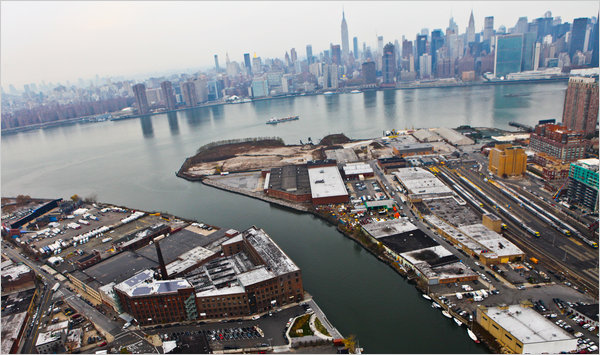
Newtown Creek, which meets the East River, has been contaminated by a series of oil spills.
Click here to read the full article.
August 2, 2010
 Photo by Penny Lee, Department of City Planning
Click here to read the full article
July 25, 2010
Click here to read the full article.
Related Content: James Dinerstein
July 1, 2010
 Becket Logan
From the windows in his studio, sculptor James Dinerstein ’69 can look out at Newtown Creek, the thin waterway separating Brooklyn from Queens.
Click here to read the full article.
March 3, 2010
Manufacturing can save our cities. We should not view it only as dying. Instead, we must rethink it within a “community-scaled” framework that produces products, jobs, skills, relationships, and stronger neighborhoods.
The familiar narrative about manufacturing in the U.S. begins at the turn of the 20th century. Manufacturing gave us prosperity.It gave us global economic power. It created a robust middle class. It ramped up at unprecedented scales to meet the demands of mass consumption, particularly in the automobile industry. Cities like Detroit (“Arsenal of Democracy”) and Philadelphia (“Workshop of the World”) were hailed as success stories of the Industrial Revolution.
This revolution did not last forever. Deindustrialization began in the post World War II years. With automation the number of workers required on the line declined significantly. As the labor movement grew in strength, companies left for the suburbs. Today corporate urban flight extends overseas, and the bastions of American industry struggle with the devastating effects of disinvestment and rising unemployment rates.
Economic development solutions for de-industrialized cities often fall into two categories. The first looks at the physical conditions of thousands of derelict buildings sitting idly across the landscape and devises programs that rehabilitate neglected industrial buildings for commercial or residential uses. E.g. former factories are converted into luxury condos. The second approach focuses on job creation by building a “knowledge-based” economy. Advances in digital technologies have sped up globalization, placing a premium on jobs in this sector. To become a “knowledge city”, cities invest in research institutions that develop technological innovations in science and engineering. Advocates believe that cities with a strong knowledge economy will increase their global competitive edge.
These prevailing approaches do not leave much room for viewing manufacturing as part of the equation for urban revitalization . Should every abandoned factory become high-end residential lofts? Is the knowledge economy the panacea for all de-industrialized cities? Instead, manufacturing is caricatured as an industry encumbered with union lobbyists or associated with a dying era, one that should step aside for the Information Age.
A Brooklyn-based non-profit is demonstrating the viability of community-scaled manufacturing. Through the acquisition, rehabilitation, and management of neglected industrial spaces, Greenpoint Manufacturing and Design Center has transformed six properties into top-rate facilities. These buildings mainly house custom-made artisanal operations, like woodworkers, upholsterers, and fabricators. Over 100 businesses reside in GMDC’s buildings, supporting over 500 workers. The majority of employees are residents from the surrounding neighborhood, showing that community-scaled manufacturing can deter fears of gentrification and displacement.
Economist E.F. Schumacher said, “If you get too many useful machines , you will get too many useless people”. By encouraging the reuse of supposedly obsolete industrial infrastructure, community-scaled manufacturing is a place-based strategy that roots manufacturers in their local areas. It addresses workforce development concerns about the lack of skilled workers. The apprentice-style education provides a way for people to discover and develop their own abilities.
Thus manufacturing becomes a step towards broadening hands-on opportunities for many people. Jobs in trade and craft are good skills; community-scaled manufacturing recovers the societal value of jobs in which people make things. Its inherent small-scale demands a localized economy and has the capacity to advance craftsmanship, promote education, and build stronger communities.
Manufacturing can, should, and is taking place in our cities. More communities are recognizing the need to localize goods and services. The local food security movement reflects this understanding. Community-scaled manufacturing can realize similar outcomes. It has the ability to bring the consumer closer to the producer, decrease the ecological footprint of manufacturing, improve local economies, and encourage self-sufficiency. We can let go of the old way of manufacturing – its polluting factories and menial labor — and embrace the future of community-scaled manufacturing.
Published: New York Post
By Aaron Short
February 19, 2010
It’s about jobs, stupid!
In her fifth State of the City address, Speaker Christine Quinn highlighted City Council’s plans to stimulate the economic recovery for New Yorkers by creating local jobs in Brooklyn and beyond.
Quinn outlined four principles to put New Yorkers back to work, which include cultivating innovation, assisting small businesses, fixes business taxes to help them expand, and reeducating New Yorkers with new skills.
“Economists are looking at statistical measures and long-term trends. Most New Yorkers are just worried about paying this month’s bills,” said Speaker Quinn. “The job of government is to see both sides of that divide. To provide immediate solutions to the problems New Yorkers face right now.”
Throughout her speech, Quinn referenced several programs that have been successful as pilots in Brooklyn as well as incidents reported from the borough that epitomized growing problems citywide.
To address the bevy of rules and regulations that small businesses confront, Quinn shared a story about a business owner in Brooklyn who received a ticket from a city inspector after a different inspector told him to move his license to another place in his business.
“I think that city inspectors are under pressure to create revenue that the city needs,” said Borough President Marty Markowitz. “Small business owners are being nickle and dimed by inspectors.”
Councilmember Vincent Gentile (D-Bay Ridge) agreed, noting that it was important to protect local businesses in Bay Ridge and the entire borough.
“I am 100 percent on board with fighting for the fair enforcement of city regulations and laws so that local businesses aren’t hurt in our city’s efforts to protect consumers and neighborhoods,” said Gentile.
With regards to softening the credit crisis and working with banks to distribute loans to small businesses, Quinn cited the Second Look program, which started upstate, that creates a specific pool of money for local businesses that have been turned down for loans. Finance Committee Chair Domenic Recchia (D-Coney Island) and Carl Hum, President of the Brooklyn Chamber of Commerce will launch the initiative.
“The finance committee will be working with banks and small business owners to get credit going,” said Recchia.
Quinn noted a new partnership that the Council has launched in Williamsburg with the Greenpoint Manufacturing and Design Center and the East Williamsburg Valley Industrial Development Corporation to purchase and renovate vacant factories in Brooklyn in order to lease the space to small manufacturers.
“One of the most rewarding accomplishments has been the implementation of the Industrial Business Zone, which protects from further reduction of space,” said Councilmember Diana Reyna (D-Williamsburg). “We fought side-by-side with community based organizations against developers to retain local jobs by preserving this structure for industrial use.”
The Speaker also highlighted a successful pilot program that Pratt Center for Development and the Bedford Stuyvesant Restoration Corporation in Bed-Stuy to retrofit an entire city block of homes with the latest weatherization initiatives. The program, which is targeted at one to four-family homes, will be expanded to one community in each borough.
“On one block, we got 25 homeowners to sign up for energy audits. It’s a way of ramping up the weatherization of buildings,” said Pratt Center Director Adam Friedman who administered the program. “Each building saves $1200 a year on energy, both electric and gas combined.”
Brooklyn Councilmembers praised Quinn’s speech, pointing out her focus on job creation and tax relief as echoing the immediate concerns of the majority of New Yorkers.
New Councilmembers Brad Lander and Steve Levin said that Quinn hit the right tone focusing on economic development and small businesses, particularly the Green Jobs Retrofit program.
Three-term Councilmember Lew Fidler, a member of Speaker Quinn’s leadership team, concurred.
“I think she had a lot of good ideas and understands the message that voters sent in November,” said Fidler (D-Mill Basin, Canarsie). “New Yorkers are tired of being taxed and ticketed and their concerns are becoming manifest in a number of our ideas.”
Related Content: 221 McKibbin Street
December 10, 2009
“The Historic Preservation Awards honor the efforts and achievement of individuals, organizations and municipalities that make significant contributions to historic preservation objectives throughout New York State,” Ash said. “The range of awards this year reflects the deep commitment and strong partnerships across the state that have made preservation an important tool for economic development. We are pleased to see that several projects involved the creation of affordable housing units, including one project that developed affordable senior housing units.”
The State Historic Preservation Awards were established in 1980 to honor excellence in the protection and rejuvenation of New York’s historic and cultural resources. Projects included several buildings adapted or rehabilitated for affordable housing and one that created affordable work spaces for small manufacturers.
The Public Policy Program, Preservation League of New York State for outstanding leadership and commitment to the development and enactment of the New York State Historic Preservation Tax Credit legislation. A multi-year effort came to fruition when legislation expanding the New York State Rehabilitation Tax Credits was approved and signed into law in July, 2009. The new law offers financial assistance to homeowners and commercial developers.
The League used one of the first applications of GIS mapping to demonstrate the potential impact of legislation during an advocacy process. Mapping and analysis demonstrated the degree to which residents and building owners would benefit from the legislation.
“I’m grateful for the Preservation League’s leadership in helping to enact New York’s most significant new statute for historic preservation in three decades,” Ash said. “The Historic Preservation Tax Credit has enormous potential to revitalize New York’s communities while preserving the history and culture that make them unique.” Developers who received awards at the ceremony noted that rehabilitation tax credits provided essential financial support for their projects.
The late Raymond V. Beecher. When the Thomas Cole house in Catskill was placed on the market in 1979, Mr. Beecher, of Coxsackie, saw past the immediate obstacles to restoring the house and property. He envisioned the site as a viable historic resource and led the Greene County Historical Society’s purchase and restoration of the property. The site was designated a National Historic Site in 1999 and opened to the public in 2001.
Mr. Beecher held a number of positions in the community including Greene County Historian, Town of Coxsackie Historian, leadership roles in the Greene County Historical Society for over 50 years and librarian at the Vedder Research Library. A prolific researcher and author, Mr. Beecher understood the importance of documenting the full record of Greene County’s built heritage. In order to raise awareness and encourage the preservation of this heritage, he initiated the establishment of the Historical Society’s Greene County Historical Register in 1990. The organization has just published the first volume of listed properties. Mr. Beecher died in October, 2008.
Knox Street Apartments, Albany for an outstanding rehabilitation project and commitment to community revitalization. WINNDevelopment Company of Rochester, NY and Boston worked in partnership with the City of Albany and the Capital City Housing Development Fund Corporation on an Urban Renewal Plan for Park South Neighborhood. The first implementation phase of the project was the rehabilitation of 18 rowhouses on Knox Street. Project consultants included The Architectural Team, Keith Construction, and Landmark Consulting.
Financing for the affordable housing project included Historic Rehabilitation Tax Credits and low income housing tax credits. The rehabilitation has proven to be a catalyst for other neighborhood projects. These included the rehabilitation of one rowhouse whose owner qualified for the first use of the New York State Rehabilitation Tax Credits for homeowners.
221 McKibben Street, Brooklyn, for an outstanding rehabilitation project and commitment to community revitalization. Greenpoint Manufacturing and Design Center (GMDC) rehabilitated the building for affordable work spaces for small manufacturing firms. Historic Rehabilitation Tax Credits and New Market Tax credits were two key financing tools. Project partners included New York City-based preservation consultants Higgins and Quasebarth, OCV Architects, Westerman Construction and PCF State Restoration.
Residential development pressures have forced many Brooklyn businesses and small manufacturing firms to close or move. By preserving an industrial site for continued use, Greenpoint Manufacturing and Design Center is preserving the industrial heritage of Brooklyn. Morton Goldfein, Chair of the GMDC, appreciated the fact that the award recognized a project that benefitted “people who work with their hands and who still have an important role in society today.”
Park Lane Apartments at Sea View, Former Nurses’ Residence of Sea View Hospital, Staten Island, for an outstanding adaptive use project and commitment to community revitalization. The Arker Companies and The Domain Companies developed the former dormitory into affordable senior housing units with the help of Historic Rehabilitation Tax Credits. Other project partners were Building Conservation Associates and Hugo S. Subotovsky, Architects, LLC. The Sea View hospital campus was constructed from 1913 to 1938 for the treatment of tuberculosis, and it was the site of clinical trials that led to the cure for the disease.
The project was the first historic structure to be funded by the New York State Energy Research and Development Authority’s affordable green design initiative program.
Packard Building, Buffalo, for an outstanding adaptive use project and commitment to community revitalization. Regan Development adapted the 1926 Packard Automobile Showroom and storage facility into affordable housing units and commercial space. Hamilton Houston, Lownie, Architects and Resetarits Construction were the consultants. The work was funded in part by Historic Rehabilitation Tax Credits and affordable housing tax credits.
The partners took extra efforts to preserve the building’s distinct character. The architects searched nationwide for a firm to custom design replacement windows. In addition, the developers chose to retain and stabilize the building’s water tower, recognizing it as one of the landmark structure’s distinguishing features.
The Genesee/Finger Lakes Regional Planning Council and the Western Erie Canal Alliance for commitment to the field of historic preservation as a tool for community revitalization. The partnership of the Genesee/Finger Lakes Regional Planning Council and the Western Erie Canal Alliance is a model for a comprehensive, regional approach to economic development programs and historic preservation programs.
The Council and the Alliance focus many of their programs on smaller communities where municipal staff may not have the benefit of historic preservation training. Their regional approach is particularly appropriate for encouraging municipalities to collaborate on the community preservation and development programs instead of trying to address economic challenges in a vacuum.
The State Historic Preservation Office (SHPO), which is part of the Office of Parks, Recreation and Historic Preservation, helps communities identify, recognize, and preserve their historic resources, and incorporate them into local improvement and economic development activities. The SHPO administers several programs including the state and federal historic rehabilitation tax credit program, state historic preservation grants, the Certified Local Government program, and the New York State and National Registers of Historic Places, which are the official lists of properties significant in the history, architecture, and archeology of the state and nation.
June 10, 2009
In Conversation with… Brian T. Coleman
CEO, Greenpoint Manufacturing and Design Center
The Greenpoint Manufacturing and Design Center (GMDC) is the premier nonprofit industrial developer in New York City. Since its inception in 1992, GMDC has rehabilitated six North Brooklyn manufacturing buildings for occupancy by small manufacturing enterprises, artisans and artists. Currently GMDC owns and manages five of these properties, which together represent more than half a million square feet of space.
Progress Express: What makes these properties work for Brooklyn manufacturers and artisans?
Brian Coleman: Small manufacturers want to be in GMDC properties for three reasons: 1) GMDC offers long term stability to the business. Our minimum lease is for five years with an option for five years, that’s generally not available in the market today. A survey of our tenants found that more than half of those businesses had moved two or more times in the five years prior to making their home at a GMDC facility. Most of these businesses come to us having been in month to month or year to year lease arrangements that gave them no stability. 2) Our lease terms are below market. We intentionally set our rates slightly below the market, but the market has been so heated up until recently that our rates have often been much more than slightly below market. Finally, 3) we are benevolent landlords. We care for our tenants, we work with them, and we help them.
PE: Where do GMDC tenants draw their workforce from?
BC: Prior to an extensive survey of our tenants, we always said anecdotally that our businesses hired community residents that surround our facilities as their employees. After the survey we knew this to be fact, and a mapping of the zip codes of the 500+ people that are employed in our facilities shows heavy concentrations directly around the locations of our buildings. The connection to the community, literally by providing residents jobs, is why I believe our facilities are so accepted by the neighborhoods in which they exist. Half of the employees in our buildings live in Brooklyn, and 94% live in New York City.
PE: Why are opportunities like those GMDC offers necessary?
BC: We all know that manufacturing in Brooklyn and New York City is not what it used to be, but we also know that manufacturing is still a viable sector that provides over 80,000 jobs. GMDC provides homes to manufacturers that provide high quality jobs to their workforce. Manufacturing jobs have always provided the immigrant community an entryway to the middle class and GMDC businesses still do. Fifty one percent of the employees of GMDC businesses speak English as a second language, and the average salary of these workers is $40,000 per year.
Brooklyn, particularly North Brooklyn where our facilities are located, has always been a manufacturing center. GMDC’s buildings are a link to this history, but house the modern day urban manufacturer. Our tenants aren’t large scale widget manufacturers churning out a mass produced product, they are small custom manufacturers creating high end products for a local market. Frankly, our tenants are also cleaner and greener than the large scale manufacturers who dominated our city were.
PE: How can this benefit the borough’s economy?
BC: Our facilities are home to over one hundred businesses that employ over 500 people; that in itself is significant to Brooklyn’s economy. Since we know that half of the employees live in Brooklyn, and most of the business owners do too, the salaries and income generated by these businesses are being recycled into the local economy.
We also know that our tenants source much of their goods and services locally in Brooklyn and certainly in New York City; this has another significant local economic effect.
Finally, the actual development of our facilities has significant economic effects on the local economy. An IMPLAN analysis of our latest project, 221 McKibbin Street, showed that the project created 101 construction jobs, $4.4 million in construction wages, and $1.4 million in local, state and federal taxes.
PE: Tell us about some recent historical preservation honors GMDC has received.
BC: Our most recent project at 221 McKibbin Street has been placed on the National Register of Historic Places, which allowed us to rehabilitate the building using a combination of Historic Tax Credits and New Markets Tax Credits. The Brooklyn Chamber of Commerce will be recognizing GMDC at the 2009 Building Brooklyn Awards, giving our 221 McKibbin Street project an award in the category of historic preservation.
Last month at a viewing on Capitol Hill, the National Development Council recognized our McKibbin Street project in the area of job creation. 221 McKibbin competed with over two hundred economic development projects from all over the United States for recognition.
PE: How does an organization like GMDC balance preservation and progress?
BC: Given the very poor condition of 221 McKibbin Street prior to the renovation, GMDC made a significant commitment to preservation in choosing to save the historic buildings. Combining the Historic Preservation Tax Credits with the New Markets Tax Credits created a powerful tool that allowed GMDC to turn dilapidated historic structures into a solid industrial center for small businesses in North Brooklyn Industrial Business Zone. The credits infused over $4 million of additional equity into the project, ultimately making the preservation of the building a key in creating a stable home where manufacturing enterprises can grow their business.
PE: How is that important to Brooklyn as a whole?
BC: Prior to its renovation, 221 McKibbin Street was in a state of extreme disrepair and was largely inactive for several years. The residential population surrounding the building – including middle-income and rental housing on McKibbin Street and public housing on Bushwick Avenue – had little interaction with the property. The renovated building has not only brought new activity and jobs to McKibbin Street; it has created an interaction between the building and this mixed-use block. The building harnesses the creative and productive energy of the area, and demonstrates that not all investments in industrial buildings have to be conversions to non-industrial uses.
PE: Has the economic downturn affected how GMDC operates, and have you learned anything from it?
BC: GMDC operates in a fairly conservative manner. Our Board and I have situated the organization to be in a strong financial position so our conservatism has proved to be a real plus, particularly in the market in which we operate today. Over the last six years we’ve consistently reduced our debt and lowered our carrying costs, a somewhat contrarian approach to what most others were doing. While the rest of the real estate community benefited greatly over the last five or so years, we’ve pretty much stayed on the sidelines because acquisition costs were such that we couldn’t purchase and renovate a building and offer reasonable rents to an industrial user.
Our McKibbin Street project was an exception, but frankly we were only able to purchase the building because it was in very poor condition and therefore the acquisition price was reasonable, particularly for the times. In addition, despite acquiring the building at a decent price, we were forced to leverage tax credits to actually get the project done. We’re hoping we can take advantage of a downturn in the market, but there don’t appear to be any bargains out their yet.
We’ve learned that our careful approach may not have allowed us to participate in the significant upside that many in the real estate industry benefited from, honestly this would have pulled us away from our mission, but we also know at the same time that we’re still standing and we’re strong enough to move forward as the economy improves. Actually this summer we’ll be building out the last 30,000 square feet of industrial space at our Manhattan Avenue facility in order to take advantage of what we believe will be considerably lower construction costs.
PE: What kind of feedback do you hear from GMDC tenants?
BC: Fortunately, most of our tenants are doing ok. A few have suffered significantly, but they appear to be in the minority. Our tenants tell me that they are working for smaller margins, but are happy to accept them in order to continue working and retain their clients and very skilled workers. A very common theme from virtually all of our tenants is that their clients are slow paying. Interestingly, a small group of our tenant businesses seem to be completely immune to the downturn in the economy. These tenants typically produce very high end goods that are still in demand at non-discounted prices. I’m most concerned about how our tenants will be fairing at the end of the year, or early next year, after the work that they have had lined up gets finished and whether or not new work begins to come in. After 9/11 GMDC tenants did ok, but the crisis didn’t really affect many of the businesses until 2003, when their orders were completed and there was no new work available.
PE: What would you like to see GMDC do in the coming year?
BC: As I said, I hope that a downturn in the market may make new development opportunities available to us, but we really don’t see much out there right now. Instead we’ll look inward and continue to make improvements to our existing facilities. We’re embarking on a plan to expand our solar capacity, enlarging what is currently the largest commercial solar power system in the City of New York. In addition, we’re also looking to make numerous energy efficiency upgrades to our existing facilities to both save money and to reduce our carbon footprint.